TWO:But in spite of Bute's incapacity the expeditions planned by Pitt were uniformly successful. The British fleets were everywhere busy attacking[174] the Spanish colonies, and cutting off the Spanish ships at sea. A fleet had been dispatched, under Admiral Rodney, at the latter end of the last year, against Martinique, carrying nearly twelve thousand men, commanded by General Monckton. They landed on the 7th of January at Cas de Navires, besieged and took Port Royal, the capital, St. Pierre, and, finally, the whole island. This was followed by the surrender of St. Vincent, Grenada, and St. Lucia, so that the English were now masters of the whole of the Caribbees. A portion of this squadron, under Sir James Douglas, then proceeded to join an expedition, which sailed from Portsmouth on the 5th of March; the fleet commanded by Admiral Sir George Pococke, and the army by the Earl of Albemarle. The squadron arrived before Havana on the 4th of June¡ªKing George's birthday¡ªand effected a landing without much difficulty.Napoleon now called up his auxiliary forces from Saxony, Würtemberg, Bavaria, and from all the Confederation of the Rhine, as well as new battalions from France, and advanced against the Russians. In the first place, the French, who had completed the subjugation of the Prussian states east of the Oder, pushed forward towards Poland, to attack the Russian general, Benningsen, who advanced to Warsaw, and occupied it in conjunction with the Prussians. Benningsen, however, finding the Prussians few and dispirited, fell back beyond the Vistula, and Murat, at the head of the French vanguard, entered Warsaw on the 28th of November. He was soon after joined there by Buonaparte, and Warsaw being put into a state of defence, the French army advanced to the Vistula and the Bug, in spite of the lateness of the season. Benningsen again retreated behind the Wkra, where he united his forces with those of Generals Buxhowden and Kaminskoi. Kaminskoi took the supreme command. When Napoleon arrived at the Wkra on the 23rd of December, he formed his army into three divisions, and forced the passages of the river. Kaminskoi fell back behind the Niemen, and the French pursued him, committing some injury on him. This trifling advantage Napoleon converted, in his bulletins to Paris, into the rout and general defeat of the Russians. It was true that the Russians were destitute of stores, having applied to Britain for money, and obtained only eighty thousand pounds. They fought, therefore, under great disadvantages, against an army furnished with everything. Notwithstanding, Benningsen, who was by far the most vigorous of their generals¡ªfor Kaminskoi was fast falling into lunacy¡ªposted himself strongly behind Pultusk, his right led by Barclay de Tolly, and his left by Ostermann. Kaminskoi ordered Benningsen to retreat, but he refused, and stood his ground. At first Tolly was driven back by Lannes and Davoust, but Benningsen converted this disadvantage into a ruse, ordering Tolly to continue his retreat, till the French were drawn on, so that he could bring down his left wing on them. This he did with such effect that he killed and wounded nearly eight thousand of them, having, however, himself five thousand killed and wounded. Lannes and five other generals were amongst the wounded. The French seized the opportunity of darkness to retreat with such speed, that the next morning not a trace of them could be seen near Pultusk. Prince Galitzin fought another division of the French the same day at Golynim, and with the same success. Had Benningsen had the chief command, and brought down the whole united Russian army on Napoleon, the victory must have been most decisive; as it was, it taught the French that they had different troops to Prussians or Austrians to contend with. They drew off, and went into winter quarters at Warsaw and the towns to the eastward. The chief command of the Russian army was now conferred on Benningsen, and so far from Buonaparte having, as he boasted, brought the war to a close with the year, we shall find Benningsen, at the head of ninety thousand men, soon forcing him into a winter campaign.
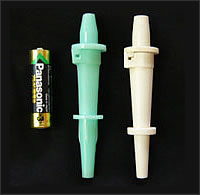
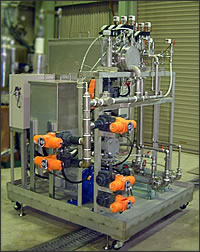
A hydrocyclone (liquid cyclone) injects treatment solution into stationary equipment to perform separation, classification, and concentration, and is an innovative separator with a very simple structure and no drive unit.
Structure of a hydrocyclone (liquid cyclone)
A suspension containing fine particles of several micrometers or more is supplied to a cylindrical container circumferentially at high speed. And as a result it starts to rotate and a centrifugal force is generated. At this time a gravitational acceleration of several tens of thousands of G is generated in the circumferential direction, and thus leading to fast sedimentation and concentration of the fine particles. The separated concentration can be freely selected by changing the supply rate (supply pressure and flow rate) and the flow ratio of the outlet. Our hydrocyclone (liquid cyclone) was designed and manufactured to classify and concentrate fine particles, and so has a small element.
THREE: Meeting of Parliament¡ªLord Chatham's Amendment to the Address¡ªThe News of Saratoga¡ªTreaty between France and America¡ªWashington in Valley Forge¡ªIntrigues against him¡ªViolation of Burgoyne's Convention¡ªDebates in Parliament¡ªAttempt to bring Chatham into the Ministry¡ªLord North's Conciliation Bills¡ªThe French Note¡ªPatriotism of the Nation¡ªThe King refuses to send for Chatham¡ªHis last Speech and Death¡ªHonours to his Memory¡ªBurke's Measure of Irish Relief¡ªRepeal of Laws against Roman Catholics¡ªExplosion of Scottish Bigotry¡ªTurgot's Warnings¡ªNaval Engagement off Ushant¡ªFailure of Lafayette's Canadian Expedition¡ªClinton compelled to evacuate Philadelphia¡ªFailure of Lord North's Commissioners¡ªD'Estaing and Sullivan attempt to take Rhode Island¡ªSubsequent Proceedings of D'Estaing¡ªCourts-martial of Keppel and Palliser¡ªThe Irish Volunteers¡ªSpain declares War¡ªMilitary Preparations¡ªJunction of the French and Spanish Fleets¡ªThey retire from the Channel¡ªD'Estaing in the West Indies¡ªHis Attempt on Savannah¡ªWeakness of Lord North's Ministry¡ªMeeting of Parliament¡ªLord North's Irish Bill¡ªRichmond, Shelburne, and Burke attempt Economic Reforms¡ªThe Meeting at York petitions for Reform of Parliament¡ªBurke's Economic Scheme¡ªNorth's Man?uvre¡ªFurther Attempts at Reform¡ªThe Westminster Meeting¡ªDunning's Motion¡ªDefeat of his later Resolutions¡ª"No Popery" in Scotland¡ªLord George Gordon's Agitation¡ªThe Riots and their Progress¡ªTheir Suppression¡ªTrial of the Prisoners¡ªRodney relieves Gibraltar¡ªDestruction of English Merchantmen¡ªDisputes with Holland¡ªThe Armed Neutrality of the North¡ªCapture of Charleston¡ªDeclaration of South Carolina¡ªBattle of Camden¡ªExpedition into North Carolina¡ªArrival of the French Squadron¡ªRodney in the West Indies¡ªArnold's Treachery¡ªTrial and Death of Andr¨¦¡ªBreach with Holland¡ªAttacks on Jersey and Gibraltar¡ªMutiny in the Army of Washington¡ªArnold's Raids in Virginia¡ªCornwallis in North Carolina¡ªHis Engagements with Greene¡ªHis March into Virginia¡ªRawdon and Greene¡ªBattle of Eutaw Springs¡ªSiege of York Town¡ªThe American Armies close round him¡ªCornwallis compelled to Surrender.
- Equipment costs can be reduced.
- Operating costs can be reduced.
- Maintenance costs can be reduced.
- Any change in raw material and product can be easily addressed.
- Large amounts can be treated in a small area.
- Separation and cleaning are easy because of the simple structure.
- Simplified control
- This equipment can be operated in synchronization with external devices.
- Alarm and interlock mechanism.
THREE:Lord Londonderry, wearied with the labours of the Session, had retired to his country seat at North Cray Farm, near Bexley, in Kent, to recruit his strength, and prepare to take his part as the representative of England at the forthcoming Congress of Verona, which was to be held in October. There, on the 12th of August, he committed suicide by cutting the carotid artery with a penknife. Lord Eldon, in a letter on the subject, says:¡ª"I learn, upon the best authority, that for two or three days he was perfectly insane; and the medical men attribute that fact to the operation upon his head of the unceasing attention to business which the last harassing Session (to him) called for." The disease would appear to have been coming on some time before; he had got the idea that he was beset by secret enemies¡ªthat he was the object of conspiracies. He was full of apprehension of being waylaid in the Park, and he felt that his life was every hour in danger. His mind gave way under the pressure of these morbid fears, and he put an end to his existence in the fifty-third year of his age. Impartial history, we think, will come to the conclusion that, with intellectual abilities not much above mediocrity, he owed his success as a statesman, in a great measure, to his fixity of purpose, and to his audacity, courage, and perseverance in adhering to his line of action in the midst of the most formidable difficulties; while the strength of his will was aided by a commanding person, an imperturbable temper, extreme affability, and winning frankness of manner. Of the policy of the Government in which he bore so long a leading part, it must be said that it was narrow, exclusive, jealous of popular rights, favourable to despotism abroad and at home, devoted to the interests of the Throne and the aristocracy, at the expense of social order and national progress. Such, at all events, was the impression of the majority of the nation, and the detestation in which the London populace held his character as a statesman was painfully evinced by the shouts of exultation which followed his coffin into Westminster Abbey, where it was deposited between the remains of Fox and Pitt. This conduct greatly shocked Lord Eldon. "This morning," he writes, "I have been much affected by attending Lord Londonderry to his grave. The concourse of people between St. James's Square and the Abbey was very great; the great bulk of them behaving decorously, some behaving otherwise; but I protest I am almost sorry to have lived till I have seen in England a collection of persons so brutalised as, upon the taking the coffin at the Abbey door out of the hearse, to have received it with cheering for joy that L. was no more. Cobbett and the paper called the[227] Statesman have, by the diabolical publications he and that paper have issued, thus demoralised these wretches."
- Classification and concentration for the manufacture of inorganic powder materials
- Classification of ceramic materials
- Removal of fine particles, including iron powder
- Removal of fine particles from pigments
- Removal of fine organic particles from solvents
- Separation of starch and yeast
- Removal of fine particles from high-temperature strong acid solutions
- Removal of fine particles from low-temperature solutions